

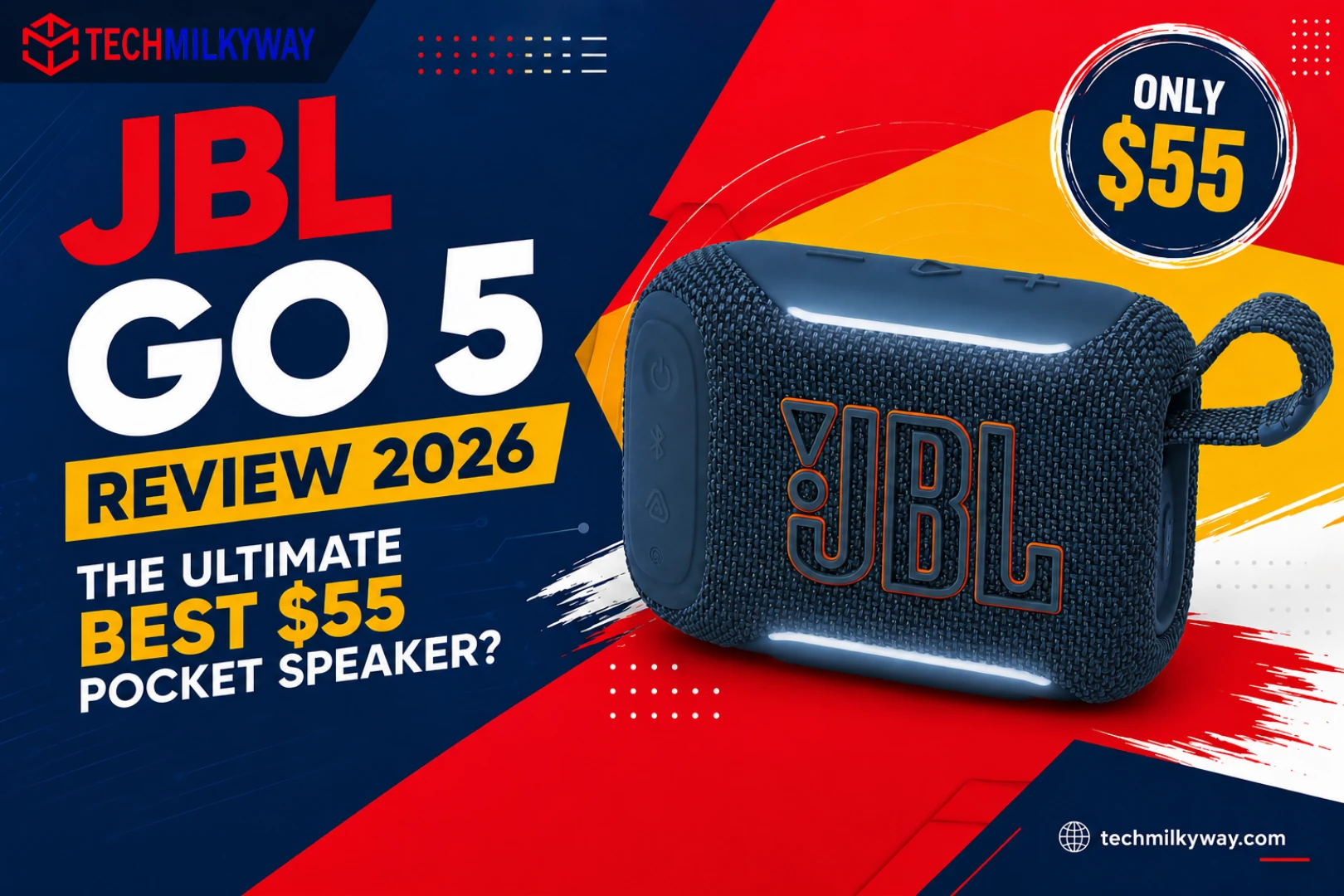
⚡ Quick Answer: The JBL Go 5 is a meaningful upgrade over the Go 4. It adds a built-in USB-C DAC for lossless wired audio, Bluetooth 6.0, an IP68 rating (up from IP67), tap-to-pair AirTouch stereo linking, and up to 10 hours of battery life with Playtime Boost — all for $54.95 USD (£35.99), just $5 more than the Go 4’s launch price. It’s the best ultra-portable speaker in its price class in 2026, though upgraders coming from a Go 4 may find the gains incremental.
JBL Go 5 Review — Specs at a Glance
| Feature | Detail |
|---|---|
| Driver | 45mm, full-range |
| Output Power | 4.8W RMS |
| Signal-to-Noise Ratio | > 85 dB |
| Frequency Range | 100 Hz – 19 kHz (-6dB) |
| Bluetooth | 6.0 (SBC, AAC, LC3) |
| Waterproofing | IP68 (waterproof + dust-proof + drop-proof) |
| Battery Life | 8 hrs standard / 10 hrs with Playtime Boost |
| Charge Time | ~3 hours via USB-C |
| Special Feature | Built-in USB-C DAC for lossless wired audio |
| Stereo Pairing | AirTouch (tap-to-pair) + Auracast |
| Weight | 230g (0.51 lb / 8.16 oz) |
| Dimensions | 101 x 77.4 x 43 mm (3.98 x 3.05 x 1.7 in) |
| Price | $54.95 USD / £35.99 |
Design and Build Quality
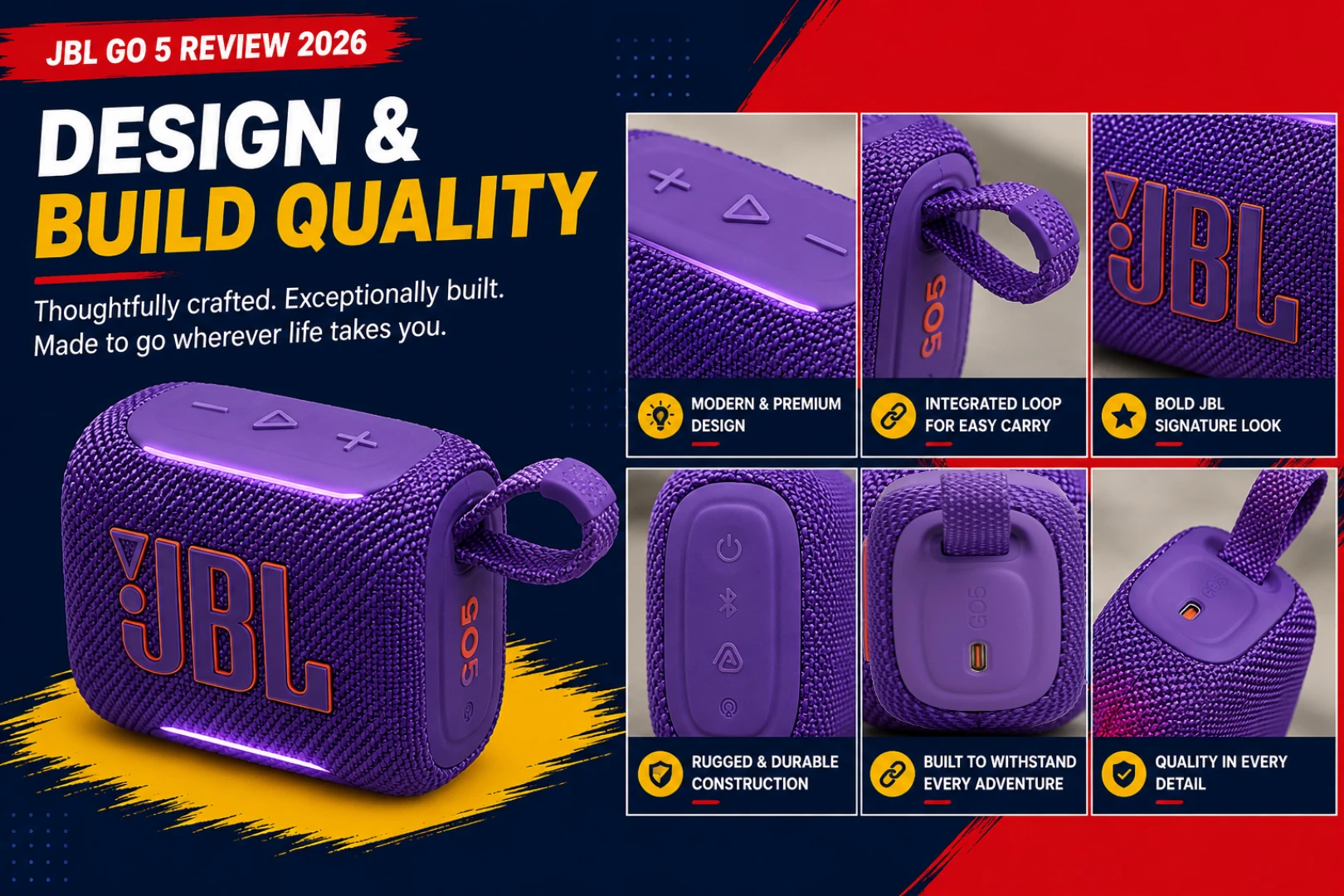
The JBL Go 5 keeps the same compact, square-but-rounded silhouette the Go series has used for years — still only slightly bigger than a pack of cards. What’s changed is what JBL added around that familiar shape.
Two thin light strips now run across the front face, giving the speaker a bit more personality than past Go models without overdoing it. The integrated carry loop remains, making it easy to clip onto a bag, bike, or backpack strap. It’s slightly heavier and larger than the Go 4 — 230g versus 190g — but that extra bulk buys real upgrades rather than just cosmetics. If durable, travel-ready gear is your thing, it’s worth also checking our Best Budget Phones in 2026 roundup for devices that hold up just as well on the road.
1. Bigger, Cleaner Sound
Output climbs from 4.2W to 4.8W RMS on the same 45mm driver, which is a 14% increase in power. In practice, that translates to more expressive highs, clearer mids, and tighter bass than the Go 4 offered — a genuine sonic step up rather than a marketing number.
Don’t expect miracles from the size, though. Physics still applies: a single 45mm driver isn’t going to deliver deep sub-bass or fill a large room, no matter how much the RMS number climbs.
2. IP68 Waterproofing
The Go 5 moves up from an IP67 rating to full IP68 protection — dust-proof, waterproof, and drop-proof. In practical terms, that means it can survive submersion in up to 1.5m of water for 30 minutes, a meaningful jump for anyone who takes their speaker to the beach, poolside, or on unpredictable outdoor trips where a Go 4 might have needed more caution.
3. Lossless USB-C Audio
This is the headline feature. The Go 5 has a built-in DAC, so plugging it into a laptop or phone via USB-C delivers lossless audio playback, bypassing Bluetooth compression entirely. On the Go 4, USB-C was charge-only — this is a genuinely rare feature to find at a $54.95 price point. If you’re building out a broader audio setup, our microphone reviews cover gear that pairs well with wired setups like this one.
4. AirTouch Stereo Pairing
Tap two Go 5 speakers together and AirTouch instantly links them for true stereo sound — no app required. Auracast support is also on board, letting you broadcast to multiple JBL Auracast-enabled speakers at once for bigger gatherings. All of this rides on Bluetooth 6.0, up from the Go 4’s older version, which adds LC3 codec support on top of the standard SBC and AAC for better sound quality at lower bitrates.
5. Ambient Edge Lighting
Twin light strips add a soft ambient glow across the speaker’s face, with four selectable effects — Bounce, Loop, Freeze, and Switch — plus visual cues for power, pairing, low battery, and Auracast mode, all managed through the JBL Portable app, which also unlocks a 7-band custom EQ (up from 5-band on the Go 4).
JBL Go 5 Review — Performance
For everyday use — commuting, outdoor hangouts, or a quick desk speaker — the Go 5 performs excellently for its size and price. The Bluetooth 6.0 connection feels stable, and the jump in output power is genuinely audible next to the Go 4.
Its strongest suit is versatility: no other speaker in this price range pairs lossless USB-C audio with IP68 durability and instant stereo pairing. Where it can’t compete is with larger portable speakers — if you want room-filling volume or deep bass, you’ll need to size up. It’s also a fun companion for handheld gaming setups; if that’s your use case, our Valve Steam Controller 2026 Review is worth a read too.
Pros and Cons
✅ Pros
- Built-in USB-C DAC enables genuine lossless wired audio
- IP68 rating — real waterproof and dust-proof protection
- AirTouch makes stereo pairing effortless
- Up to 10 hours of battery life with Playtime Boost
- 7-band custom EQ via the JBL Portable app
- Only a modest $5 price increase over the Go 4 for a meaningful jump in durability and sound
❌ Cons
- Only incremental gains for existing Go 4 owners
- Still limited by a single small 45mm driver — no deep bass or high volume
- 3-hour charge time feels slow for a 1000mAh battery
- Added weight (230g vs. 190g) from the new lighting hardware
Should You Buy the JBL Go 5?
Buy it if:
- You want an affordable, genuinely portable speaker for daily use
- You’re curious about lossless USB-C audio on a budget
- You need real waterproofing for beach, pool, or outdoor trips
- You want simple tap-to-pair stereo sound without digging through an app
Skip it if:
- You already own a Go 4 and don’t need the DAC or extra waterproofing
- You want deep bass or loud, room-filling sound
- You need faster charging for quick top-ups
TechMilkyWay Verdict
The JBL Go 5 proves that “budget speaker” doesn’t have to mean “basic speaker.” Between the IP68 rating, Bluetooth 6.0, and a lossless USB-C DAC, it punches well above its size and price class. For anyone shopping the ultra-portable speaker category in 2026, this is one of the easiest recommendations we can make — though Go 4 owners can comfortably sit this generation out. Browse more picks in our full Audio category if you’re comparing options before you buy.
Where to Buy the JBL Go 5
- 🛒 Check Price on Amazon Us — 7 colors in the US (Black, Blue, Purple, Red, Teal, White, Squad);
- 🛒 Check Price on Amazon UK – the UK store lists Black, Blue, Pink, Purple, Red, Squad, and White (no Teal)
- 🛒 Buy Direct — JBL.com
Best Alternatives to the JBL Go 5
| Speaker | Price | Best For | Buy on Amazon |
|---|---|---|---|
| Soundcore Select 4 Go | $34.99 (often on sale for ~$24.99) | Cheapest solid option, 20-hr battery | Check Price |
| Tribit Stormbox Micro 2 | $59.99 | Best rated in this size class | Check Price |
| JBL Go 4 | $49.95 (frequently on sale for $38–40) | Budget buyers who don’t need the DAC | Check Price |
| Tribit Stormbox Micro 3 | $64.99 | Longer battery life (24 hrs), similar footprint | Check Price |
| JBL Clip 5 | $79.95 (often on sale for ~$69.95) | Clip-on portability for bags and belt loops | Check Price |
| Sony SRS-XB100 | $64.99 (often on sale for ~$33.99) | Simple, no-frills sound with 16-hr battery | Check Price |
| Marshall Emberton III | $179.99 (frequently discounted to $100–130) | Style-focused buyers who want standout design | Check Price |
Note: Amazon prices fluctuate — go to live product page for latest price, shown prices are recent list/sale prices at time of writing.
Frequently Asked Questions
Is the JBL Go 5 waterproof? Yes. It carries an IP68 rating, protecting it against dust, submersion, and drops.
How long does the JBL Go 5 battery last? Up to 8 hours in standard mode, or 10 hours with Playtime Boost enabled.
Can I pair two JBL Go 5 speakers together? Yes, using AirTouch — simply tap two units together for instant stereo pairing.
Does the JBL Go 5 support lossless audio? Yes, via its built-in USB-C DAC, letting you stream lossless audio when connected by cable.
What is the JBL Go 5 price? It’s priced at $54.95 USD (£35.99), about $5 more than the JBL Go 4’s launch price — a jump reviewers say is justified by the Go 5’s improved sound and durability.
More From TechMilkyWay
- 🔊 Best Budget Laptops in 2026
- 📱 Best Budget Phones in 2026
- 🎮 Valve Steam Controller 2026 Review
- 🤖 18 Best AI Apps Everyone Is Using in 2026
🌌TechMilkyWay — Navigating the Universe of Technology.
Quick Links: Home | Audio | Reviews | Blog | Contact Us | Facebook
Affiliate Disclosure: TechMilkyWay participates in the Amazon Associates Program. If you purchase through our links, we may earn a small commission at no extra cost to you.
© 2026 TechMilkyWay. All rights reserved.
ASUS ROG Azoth Keyboards Series 2026: Which Model Should You Buy?