
The Ultimate Wireless Headphones Buying Guide 2026 : 7 Things to Know Before You Buy

Are you looking for the best wireless headphones, earbuds, TWS, or neckband in 2026? You are in the right place.
This wireless headphones buying guide will help you avoid the most common and costly mistakes buyers make — spending money on the wrong form factor, falling for fake ANC claims, or picking up a counterfeit product. Whether you are shopping for over-ear wireless headphones, TWS earbuds, or a neckband, this complete wireless headphones buying guide covers everything you need to know before you spend a single dollar.
Quick Answer: Before buying any wireless headphones, TWS earbuds, or neckband in 2026, check for true Active Noise Cancellation, the right Bluetooth codec, a comfortable fit, an IPX water resistance rating, battery life, microphone quality, and always purchase from a verified source. This wireless headphones buying guide will walk you through each factor in detail.
What Are the Different Types of Wireless Audio Devices?
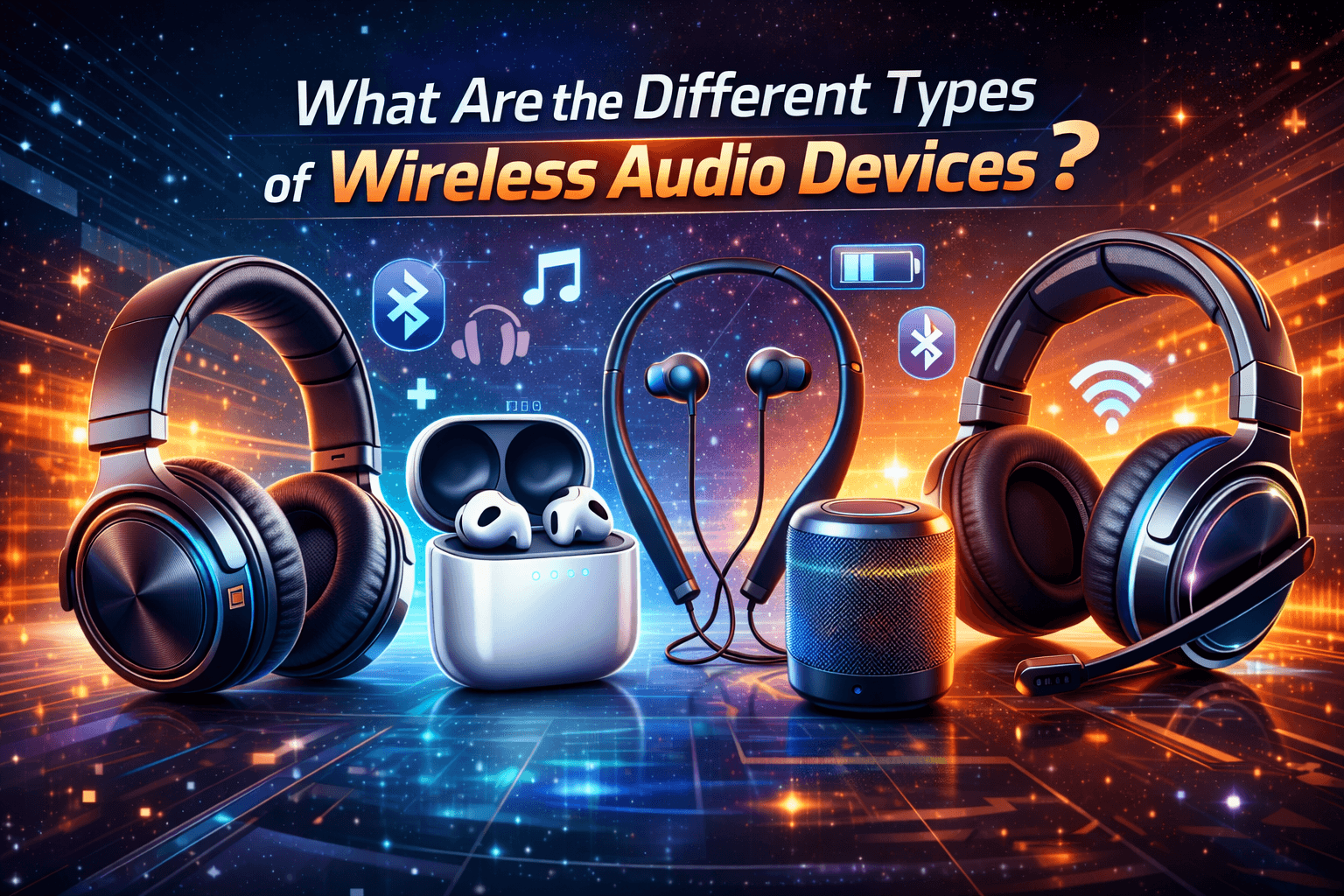
Not all wireless audio devices are built the same. Each form factor serves a different purpose, and choosing the wrong one for your lifestyle is the single most common buying mistake.
| Form Factor | Best For | Main Trade-Off |
|---|---|---|
| Over-Ear Headphones | Home, studio, long sessions, flights | Bulky, not suited for workouts |
| On-Ear Headphones | Office, casual commuting | Less isolation, pressure over time |
| TWS Earbuds | Commuting, gym, everyday use | Shorter battery per charge |
| Neckband Earphones | Long calls, exercise, budget buyers | Less convenient than TWS |
Over-Ear Headphones wrap fully around the ear for the best passive isolation, richest sound, and most comfort for long sessions. They are not pocket-friendly. Best for home listening, remote work, and long-haul flights.
On-Ear Headphones sit on the outer ear — lighter and more compact, but with less isolation and potential pressure fatigue over time. Best for office use and casual daily commuting.
TWS (True Wireless Stereo) Earbuds have no cable at all — the most popular wireless audio category in 2026. Smaller individual batteries are offset by the charging case. Best for commuting, workouts, and all-day versatile use.
Neckband Earphones connect two earpieces via a flexible band that sits around the neck. The band houses a large battery, giving neckbands the longest single-charge playback of any portable form factor. Best for frequent call-makers, gym users who want stability, and budget buyers who want reliable audio.
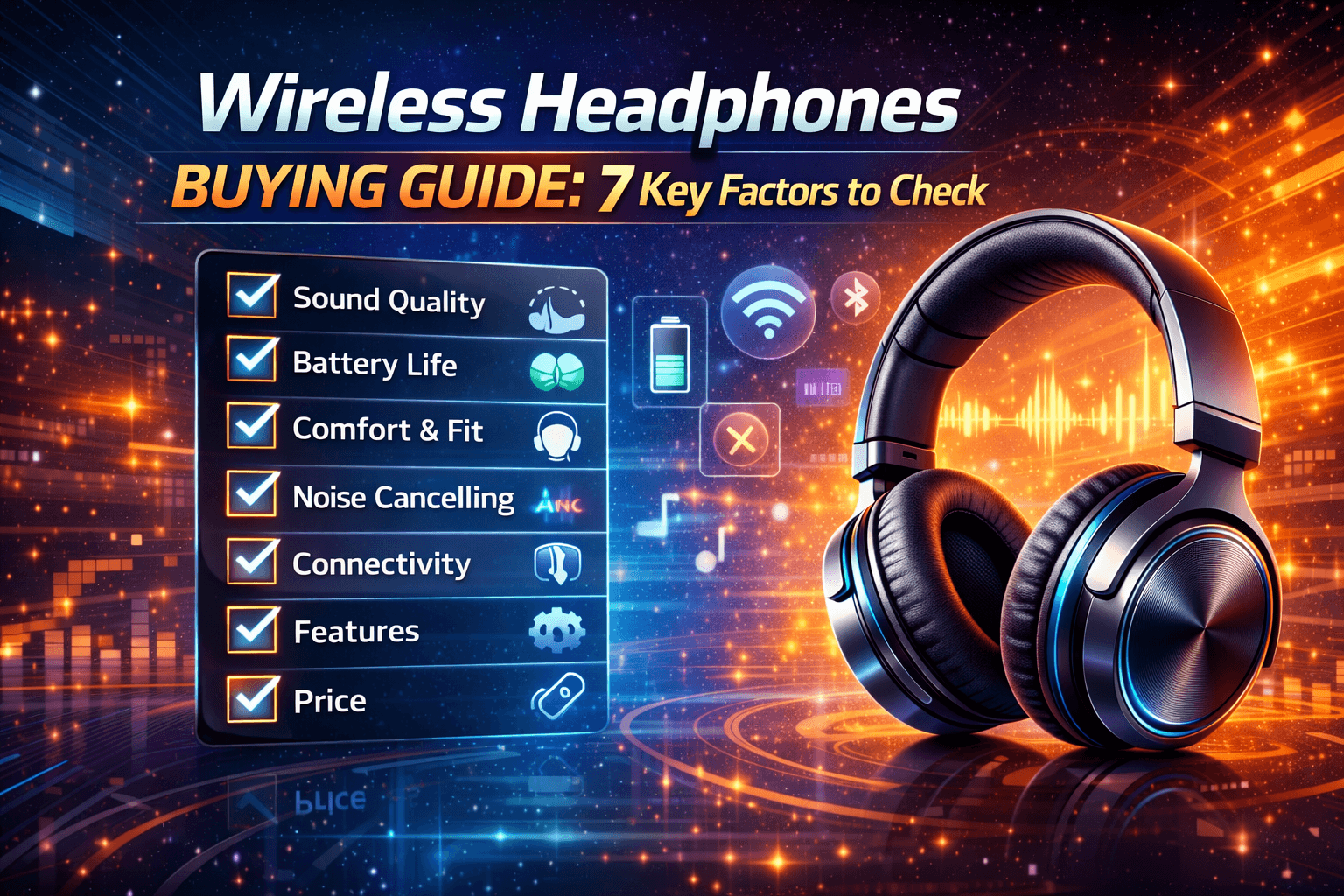
Wireless Headphones Buying Guide: 7 Key Factors to Check
1. Active Noise Cancellation — Real ANC vs. Passive Isolation
One of the most misused terms in wireless headphones and earbuds marketing is “noise cancellation.” Here is what the two terms actually mean.
Passive noise isolation is the physical blocking of ambient sound by the ear cup seal or ear tip. Every audio device offers some degree of this — it costs nothing extra to produce and requires no electronics.
Active Noise Cancellation (ANC) is a completely different technology. It uses built-in microphones to detect ambient noise in real time and generates an opposing audio signal that electronically cancels it. The result is a genuine, dramatic reduction in background sound — engine rumble, crowd noise, HVAC hum — that passive isolation simply cannot match.
Marketing phrases like “noise reduction,” “noise blocking,” and “immersive sound” often refer only to passive isolation. Always look for the specific words “Active Noise Cancellation” in the product spec sheet.
ANC performance by form factor:
- Over-ear headphones achieve 30dB–45dB of ANC — the best in any portable category, thanks to larger ear cups and more room for microphones.
- TWS earbuds typically deliver 20dB–40dB. Performance varies significantly between models even at the same price point.
- Neckbands with genuine ANC exist but are less common at budget prices. Verify ANC explicitly — do not assume.
Pro Tip: Read reviews that test noise cancellation in real-world environments like trains, coffee shops, and open offices — not just in anechoic chambers. Lab dB ratings do not always reflect everyday performance.
2. Bluetooth Version and Audio Codec
The Bluetooth version and the audio codec work together to determine connection stability, audio quality, and latency. Both are frequently overlooked by buyers.
Bluetooth 5.3 is the current standard in 2026. Key benefits over older versions include faster pairing, a more stable connection at longer range, lower power consumption, and native support for multipoint connectivity — staying paired to two devices simultaneously, which makes switching between a phone and laptop seamless.
The audio codec compresses and transmits the audio signal. It directly determines sound quality and, critically for gamers and video watchers, latency.
| Codec | Audio Quality | Latency | Best Use |
|---|---|---|---|
| SBC | Basic | High | Universal fallback |
| AAC | Good | Moderate | iPhone and Apple devices |
| aptX / aptX HD | Better | Moderate | Android devices |
| aptX Adaptive | Excellent | Low | Premium Android |
| aptX Low Latency | Good | Very Low | Gaming and video |
| LC3 (LE Audio) | Excellent | Very Low | Bluetooth 5.2+ devices |
| LDAC | Hi-Res Audio | Moderate | Sony devices and Android |
For music listening, LDAC, aptX Adaptive, or LC3 deliver the best quality. For gaming or watching videos, aptX Low Latency or LC3 are essential to eliminate audio sync issues.
Important: Both your wireless audio device and your source device — phone, laptop, or tablet — must support the same codec for it to activate. Always verify codec compatibility on both ends before purchasing.
For phones that support the latest audio codecs, check our Best Budget Phones in 2026 roundup. For the official technical standard behind LC3 and Bluetooth LE Audio, see the Bluetooth SIG LE Audio overview — it is the authoritative reference for codec specifications.
3. Comfort and Ergonomics for Wireless Earbuds and Headphones
A wireless headphone or earbud that causes pain or discomfort after 30 minutes is a product you will stop using, regardless of how good it sounds.
Over-ear and on-ear headphones:
- Look for memory foam ear cushions over basic foam or hard plastic padding
- Check headband padding and clamping force — excessive clamping causes headaches during long sessions
- Adjustable sliders and swiveling ear cups adapt to different head shapes and sizes
- Aim for under 300g for headphones worn for hours at a stretch
TWS earbuds:
- Multiple ear tip sizes (Small, Medium, Large minimum) are non-negotiable — the right seal affects both comfort and sound quality directly
- Silicone tips are softer and suited for all-day wear; memory foam tips create a tighter seal and better passive isolation
- Ear fins or wing tips are important if you plan to use earbuds during workouts
- Angled housing designs distribute weight more evenly in the ear canal than bulkier round designs
Neckband earphones:
- Soft, flexible band material — silicone or rubberized finishes — prevents neck irritation during extended wear
- Magnetic earpiece tips that snap together when not in use are a practical convenience feature that also triggers auto-pause on most models
4. IPX Water Resistance Rating for Headphones and Earbuds
Sweat and moisture damage are among the leading causes of early failure in wireless audio devices — and they are rarely covered by warranty without an IPX rating.
| IPX Rating | Protection Level | Recommended For |
|---|---|---|
| No Rating | No protection | Home use only |
| IPX4 | Splashes from any direction | Light workouts, daily commuting |
| IPX5 | Sustained low-pressure water stream | Intense gym sessions, light rain |
| IPX6 | High-pressure water jets | Outdoor sports, heavy rain |
| IPX7 | Submersion up to 1m for 30 minutes | Swimming and water sports |
By form factor:
- Most over-ear headphones offer IPX4 at best — keep them away from sweat-heavy workouts.
- For TWS earbuds and neckbands, IPX5 is the minimum standard if you plan to use them during exercise.
Always confirm the IPX rating in the technical specification sheet — not in marketing copy, which is frequently vague or absent entirely.
5. Battery Life and Fast Charging
Battery specifications are among the most overstated figures in wireless audio. Manufacturers quote maximum battery life at low volume with ANC off. Real-world performance — at normal volume with ANC enabled — is consistently lower.
Use these practical benchmarks when comparing products:
| Form Factor | Per Charge (ANC On) | Full Battery / With Case | Fast Charge |
|---|---|---|---|
| Over-Ear Headphones | 25–35 hours | N/A | 10 min → 3–5 hrs playback |
| TWS Earbuds | 5–8 hours | 20–36 hrs with case | 10 min → 1–2 hrs playback |
| Neckband Earphones | 15–25 hours | N/A | 15 min → 3–4 hrs playback |
Over-ear headphones hold the largest internal battery and deliver the longest single-charge playback of any form factor. Neckbands outlast TWS earbuds per charge because the band houses a bigger cell. TWS earbuds compensate with the charging case, giving you multiple top-ups on the go.
Wireless charging (Qi) is increasingly common on premium TWS cases and is a useful bonus if you already use a wireless pad for your phone or smartwatch.
6. Microphone Quality for Calls
Microphone performance is consistently underreported in wireless audio reviews. If you regularly take work calls, join video meetings, or use voice assistants, call quality matters as much as the drivers themselves.
What to look for:
- Multiple microphones for improved voice pickup and background noise filtering
- Beamforming technology that focuses microphone sensitivity toward your voice and away from ambient sound
- AI-based call noise reduction for cleaner speech in busy environments
By form factor:
- Over-ear headphones: Business-oriented models are engineered for call clarity; consumer-focused headphones vary widely — check call quality reviews specifically.
- TWS earbuds: Call quality does not always match music performance. A pair that sounds excellent for music can still be mediocre on calls. Always check dedicated call tests before buying.
- Neckband earphones: The microphone typically sits on the band near the collarbone. Directional microphone quality matters more here since the mic is further from the mouth.
7. Buy Only From a Verified Source
Counterfeit wireless audio products are a serious and widespread problem. Fake versions of popular headphones and earbuds — from brands like Sony, JBL, Bose, and Apple — circulate heavily on unregulated online marketplaces. These fakes replicate the external appearance convincingly but deliver inferior sound, no genuine ANC, shorter battery life, and no valid warranty support.
How to protect yourself:
- Always purchase from the brand’s official store or an authorized retailer
- Look for a clear return policy and warranty documentation before ordering
- Be skeptical of prices that are significantly lower than the standard retail price — counterfeit earbuds are often sold as “deals”
- On Amazon, verify whether the seller is the brand itself or a well-reviewed, officially authorized third party
For more vetted gear recommendations across every category, visit our Gadgets & Accessories section.
Which Wireless Audio Device Should You Buy?
Use this quick decision table to find the right form factor for your specific needs:
| My Priority Is… | Best Choice |
|---|---|
| Best sound quality for home listening | Over-ear wireless headphones |
| One pair that does everything | TWS earbuds with ANC and IPX5+ |
| Maximum battery life for long calls | Neckband earphones |
| Blocking noise in a loud office or on flights | Over-ear headphones with strong ANC (35dB+) |
| Workout use without anything falling out | Neckband or TWS earbuds with ear fins |
| Gaming or video with zero audio lag | TWS earbuds with aptX Low Latency or LC3 |
| Budget-friendly all-day audio | Neckband earphones |
Frequently Asked Questions About Wireless Headphones and Earbuds
What is the difference between TWS earbuds and regular wireless earbuds? TWS (True Wireless Stereo) means there is no cable at all — not between the two earpieces and not from the earpieces to the source device. Regular wireless earbuds have a short cable connecting the two earpieces, similar to a neckband style. TWS earbuds offer maximum freedom of movement but have smaller individual batteries.
Are over-ear headphones better than TWS earbuds for sound quality? Generally yes — larger drivers in over-ear headphones produce a wider soundstage and richer bass. However, the gap has narrowed significantly in 2026. Premium TWS earbuds from Sony, Bose, and Apple now compete seriously with mid-range over-ear headphones on sound quality.
Do neckband earphones have good ANC? Active Noise Cancellation is less common in neckband earphones than in TWS earbuds or over-ear headphones. Most neckbands at budget price points rely on passive isolation from the ear tip seal. If ANC is a priority, TWS earbuds or over-ear headphones are a safer choice.
What IPX rating do I need for gym use? IPX5 is the practical minimum for regular gym use. It handles sweat and occasional splashes confidently. IPX4 is acceptable only for light, low-intensity workouts.
Which is better for calls — neckband or TWS earbuds? Both can perform well, but neckband earphones have a natural stability advantage outdoors since the microphone sits on a fixed band rather than inside a small moving earbud. Premium TWS earbuds with beamforming and AI call noise reduction can match or exceed neckband call quality indoors.
Is Bluetooth 5.3 important for wireless headphones in 2026? Yes. Bluetooth 5.3 offers a more stable connection, lower power draw, multipoint device support, and native support for the LC3 codec — which delivers both high audio quality and very low latency. For music-only use, older Bluetooth versions may work fine. For gaming, video, and multi-device workflows, Bluetooth 5.3 is worth seeking out.
Final Thoughts on the Wireless Headphones and Earbuds Buying Guide 2026
Buying wireless headphones, TWS earbuds, or a neckband in 2026 does not have to be overwhelming. The market has more genuinely excellent options than ever — but only if you know what to look for.
Confirm genuine ANC, check codec compatibility, prioritize comfort for your specific use case, verify the IPX rating, compare realistic battery figures, and always buy from a verified source. Get those seven things right and your next wireless audio purchase will be one you use every single day.
For more coverage on the best tech in 2026, explore TechMilkyWay — Navigating the Universe of Technology. If you game with your audio gear, our Best Games to Play in 2026 guide is worth a read. And for the best phones to pair with your new wireless audio device, check out our Best Budget Phones in 2026 roundup.
TechMilkyWay – Navigating the Universe of Technology
Quick Link : Home | Blog | Contact Us | Facebook | Instagram | X
© 2026 TechMilkyWay. All rights reserved.
Read More:
Top 10 Most Popular and Best Games to Play in 2026 Right Now